

Hi There!
This week’s Sustainability Round Up arrives as global momentum both for and against climate and corporate sustainability action hits a pivotal moment from weakened EU sustainability rules to sharp geopolitical rifts over net zero at the IEA, and India hosting a global summit on sustainable development. These contrasting forces underscore a year where strategic choices by governments and businesses will define whether sustainability commitments translate into credible action or retreat. Dive in for more!


1. EU countries approve scaled-back sustainability laws
After sustained pressure from member states and industry groups, the EU formally diluted its Corporate Sustainability Due Diligence framework, narrowing scope to the largest companies and removing mandatory climate transition plans while delaying compliance timelines. The move reframes sustainability from a systemic accountability mechanism to a competitiveness adjustment tool, signalling that economic headwinds now outweigh regulatory ambition. This shift lowers the regulatory floor globally and may incentivise firms to treat sustainability as reputational risk management rather than structural value chain transformation, while exposing the EU to credibility erosion in climate leadership.
2. US gives ultimatum to IEA over global net zero
The United States has reportedly threatened to reconsider its position within the International Energy Agency unless net zero pathways are removed from flagship outlooks, injecting political pressure into what has been treated as technocratic energy modelling. This represents a deeper politicisation of energy transition scenarios, where data and climate science become subject to domestic electoral cycles. If multilateral energy institutions are forced to dilute net zero assumptions, investors and corporates lose a shared transition reference point, increasing uncertainty in long term capital allocation for renewables, grids, and low carbon infrastructure.
3. Environmental toll of Winter Olympics exposes Greenwashing
Investigations into the 2026 Winter Games highlight forest loss, heavy artificial snow dependence, and ecosystem strain despite official carbon neutral claims, revealing the structural environmental cost of hosting mega events in climate stressed regions. The narrative exposes how event level offsets and branding can obscure lifecycle impacts embedded in construction, transport, and resource intensity.
Without standardised, independently verified impact accounting, large scale events risk normalising symbolic sustainability commitments while perpetuating high carbon infrastructure models that contradict long term climate resilience.

In Boeske’s “Leadership towards Sustainability: A Review of Sustainable, Sustainability, and Environmental Leadership” the paper synthesises decades of academic research to differentiate how distinct leadership approaches influence sustainability strategy across organisations. Boeske clarifies that environmental leadership often focuses on operational efficiency, sustainability leadership aligns economic, social, and environmental goals, and sustainable leadership drives systemic change by embedding long-term value creation across stakeholders.
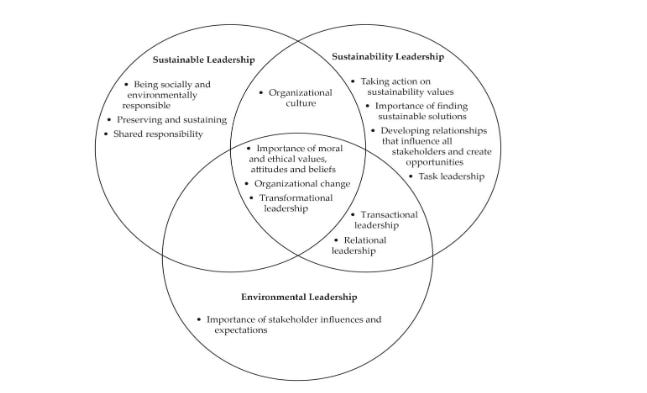
Image Courtesy - Fig 1. Boeske (2023), Sustainability, 15(16), 12626. CC BY 4.0.
The review shows that leadership is not a soft variable but a structural driver of strategy execution. Leaders influence governance priorities, innovation orientation, employee engagement, and stakeholder collaboration, which in turn determine whether sustainability remains a peripheral initiative or becomes embedded in core business models. Innovation emerges not from isolated R and D investments but from leadership behaviours that align culture, incentives, and long term vision.
The core insight is strategic. Sustainability outcomes depend less on stated commitments and more on the type of leadership logic guiding the organisation. Without leadership that integrates environmental and social objectives into strategic decision making, sustainability risks remaining operational optimisation rather than transformative change. Read the full research here.

United Nations Secretary-General António Guterres at The AI Impact Summit, India presents an optimistic case that artificial intelligence, supported by digital public infrastructure, can move from pilots to population scale in low resource contexts. The panel highlights measurable gains in service delivery and inclusion, yet it largely assumes that technical scalability will automatically translate into equitable impact.
A more critical lens suggests that AI adoption remains uneven and often concentrated at managerial levels, while frontline employees and intended beneficiaries experience limited direct benefit. In many emerging contexts, weak digital literacy, infrastructure gaps, funding volatility, and unclear accountability frameworks slow meaningful deployment, raising the question of when and how promised productivity or inclusion gains will reach the bottom of the pyramid.
For sustainability leaders, the lesson is clear: without deliberate workforce transition planning, capacity building, and safeguards against displacement or exclusion, AI risks reinforcing inequality rather than advancing social sustainability.

Last time’s poll shows a clear preference for global science based standards at 45%, signalling that leaders prioritise long term credibility over shifting local regulations. Sustainability is increasingly viewed as strategic positioning, not just compliance. Read our last post here.
Missed our recent issues? Catch up anytime by reading our full archive here 📖.
That’s it for today’s roundup! We’ll see you next Thursday with another set of inspiring sustainability news and updates. Until then, take a moment to reflect on how you can adopt one new sustainable practice this week. Every small step counts! 🌍✨
Have any thoughts or a sustainable practice you'd like to share? Share your feedback here.
Together, we can make a difference. See you in the next edition of the Sustainability Roundup!
Love this! I recently came across this duo in SF plant seeds on their hoverboards, and I’m totally obsessed with how easy it is to be in nature and celebrated wherever you are. Would love your thoughts on the piece! https://arshiyaarora.substack.com/p/susstories-seasoning-the-earth-how?r=3pcwen&utm_medium=ios