

Welcome back to this week’s Sustainability Roundup!
One of the biggest misconceptions in business is that sustainability is about managing external risks. Increasingly, it is shaping the competitive environment itself. This week, from AI infrastructure and climate finance to extreme heat disrupting global events, the real story is that sustainability is redefining how organisations access markets, allocate capital and build resilience in an increasingly resource constrained world.
Find out more below!


1. How a Hotter Planet Is Changing the Business of Sports
As extreme heat increasingly disrupts sporting events, organisers are redesigning schedules, infrastructure and athlete safety protocols to adapt to a changing climate. The shift demonstrates that climate adaptation is no longer a contingency plan but an operational capability. For businesses, the lesson extends beyond sport. Organisations that continue to view climate risk as a future concern may find their assets, workforce and customer experience increasingly exposed, making adaptation a source of resilience and competitive advantage rather than simply a cost.
2. New York Becomes the First US State to Impose a Data Centre Moratorium
New York has imposed a temporary moratorium on large data centres over concerns around electricity demand, water consumption and rising energy costs. The decision signals that access to infrastructure is becoming as much a social and environmental challenge as a technological one. As AI accelerates, companies can no longer assume that capital alone determines growth. Securing community trust, resource availability and regulatory support is increasingly becoming a prerequisite for scaling digital infrastructure.
3. Development Banks Reach Record Climate Finance Despite Growing Policy Uncertainty
Multilateral development banks committed record levels of climate finance even as uncertainty grows following the World Bank’s retreat from its previous climate lending ambitions. The contrast highlights a fragmented transition where capital for sustainability continues to expand but policy certainty is weakening. Rather than relying on stable government support, businesses will increasingly need to diversify financing sources and build investment strategies that remain resilient amid shifting political and economic priorities.

Many organisations assume sustainability communication is about reporting progress. In reality, every public climate target or net zero pledge is a strategic promise that shapes investor expectations, stakeholder trust and executive accountability long before results are delivered.
Research published in the Strategic Communication: A New Perspective for Strategic Management, introduces the concept of the CEO Promise, arguing that strategic commitments create value only when they are public, future oriented, expressed with commitment, firm specific, beneficial to stakeholders and material enough that failure would damage credibility. Analysing more than 69,000 earnings calls from S&P 1500 companies, the authors found:
Sustainability promises have the longest average time horizon (33.7 months) of any CEO commitment, meaning leaders remain accountable for them far longer than growth, cost reduction or innovation initiatives (see figure).
Every public sustainability commitment strengthens legitimacy but also reduces strategic flexibility if business conditions change.
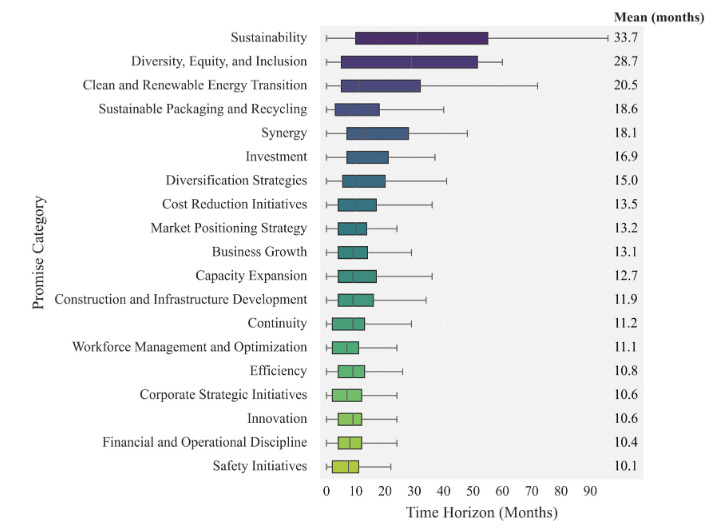
Image courtesy: Fig 3, Strategic Communication: A New Perspective for Strategic Management, Strategic Management Journal (2025)
Credibility is built through consistently delivering on a few meaningful promises rather than announcing increasingly ambitious targets.
The strongest sustainability communication aligns commitments with governance, resources and execution.
As sustainability becomes a source of competitive advantage, organisations will be judged less by the promises they make and more by their ability to deliver on long term commitments that markets remember long after they are announced.

Climate change is rapidly transforming the Arctic into a strategic corridor for shipping, energy and critical minerals. This video shows how melting ice is reshaping geopolitical influence, trade routes and resource competition, highlighting that sustainability is no longer just about managing environmental risks but also anticipating shifts in global markets and national security.
It is a powerful reminder that climate change creates winners and losers, making geopolitical foresight an essential capability for long term sustainability strategy.

Results from last week's poll suggest that sustainability is increasingly viewed as a tool for protecting business value rather than creating it. With 38% choosing risk reduction, respondents recognise that resilience against climate, regulatory and geopolitical disruptions is becoming a core source of long term competitive advantage. Missed our last edition? Read it here.
Missed our recent issues? Catch up anytime by reading our full archive here 📖.
That’s it for today’s roundup! We’ll see you next Thursday with another set of inspiring sustainability news and updates. Until then, take a moment to reflect on how you can adopt one new sustainable practice this week. Every small step counts! 🌍✨
Have any thoughts or a sustainable practice you'd like to share? Share your feedback here.
Together, we can make a difference. See you in the next edition of the Sustainability Roundup!