

Welcome back to this week’s Sustainability Roundup!
For years, sustainability has been framed as a challenge of reducing environmental impacts. This week’s stories suggest something deeper is changing. From clean energy that cannot reach consumers, to labour shortages triggered by migration policy, to growing scrutiny of the social impacts of digital products, the common thread is not sustainability ambition but system resilience.
Scroll down for this week’s insights!

1. China’s Clean Power Problem
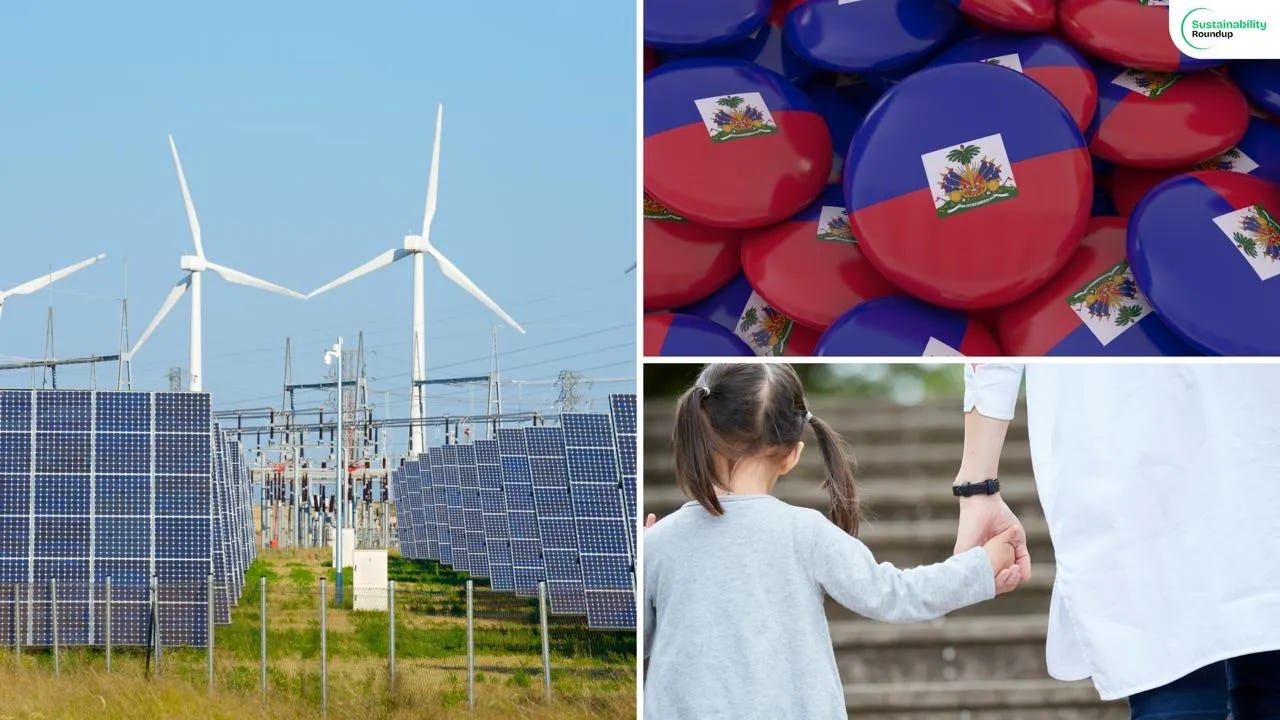
China discarded enough clean electricity to power Mexico for a year in the first half of 2026 as its grid struggled to absorb surging solar and wind generation. Similar bottlenecks are emerging across India, Japan and Australia, suggesting the energy transition is entering a new phase. For years, the challenge was building more renewable energy. Today, the challenge is using it. The assumption that more clean energy automatically means less fossil fuel use is breaking down as transmission networks, storage capacity and grid flexibility fail to keep pace. The next competitive advantage may not come from generating clean power, but from storing and managing it effectively.
2. Haitian Immigration Crackdown Disrupts US Care Systems
The removal of work authorization for thousands of Haitian migrants is creating staffing shortages across US healthcare systems, with nursing homes, disability services and care providers struggling to replace experienced workers. Yet beneath the political debate lies a sustainability challenge that receives far less attention: human capital flows. Businesses tend to treat migration as a political issue, yet entire sectors increasingly depend on migrant workers to fill labour, skills and demographic gaps. As climate change, conflict and economic instability reshape migration patterns, organizations will need to think beyond emissions and resource security to workforce security. Migration and reverse migration are becoming material sustainability risks capable of disrupting care systems, supply chains and economic resilience just as significantly as physical climate impacts.
3. Meta Faces Trial Over Child Safety
A landmark trial against Meta heard testimony from a former engineering director who alleged that growth and engagement were consistently prioritised over child safety on Facebook and Instagram. Beyond social media, the case reflects a broader shift in sustainability expectations. For years, companies could externalise social harms while maximising growth. That social licence is eroding. Whether the issue is youth mental health, AI safety or worker wellbeing, stakeholders increasingly expect businesses to take responsibility for the downstream consequences of their products. The strategic question is no longer whether a product creates value, but whether it creates value without creating unacceptable social costs. Companies that fail to answer that question may find regulators, courts and investors answering it for them.

Sustainability strategies assume that solutions can be replicated across markets with minimal adaptation. The CAGE Distance Framework, developed by Pankaj Ghemawat, challenges this assumption by arguing that cross border success depends on understanding four forms of distance between countries: Cultural, Administrative, Geographic and Economic. Sustainability initiatives often fail not because the solution is flawed, but because organisations underestimate these differences.
The framework offers four strategic insights:
Cultural Distance influences how consumers, employees and communities perceive sustainability issues. Climate messaging, circular economy initiatives and responsible consumption campaigns may resonate differently across markets.
Administrative Distance shapes exposure to regulations, reporting requirements, carbon pricing mechanisms and sustainability standards. The same strategy may face entirely different compliance realities across jurisdictions.
Geographic Distance affects supply chain resilience, resource availability, logistics emissions and climate risks. Physical location remains a critical determinant of sustainability performance.
Economic Distance influences affordability, purchasing power and willingness to pay for sustainable products. Solutions designed for developed markets may struggle in regions where cost remains the primary decision factor.
Organizations can no longer assume that what works in one market will work in another. As sustainability expectations fragment across regions, leaders must actively reassess whether their strategies are designed for the realities they face, not the ones they assume.

Listen to FullCycle founder, Ibrahim AlHusseini argues that climate solutions do not scale because they are environmentally beneficial; they scale when investors can make money from them.
He highlights overlooked pollutants such as methane and refrigerant gases, which contribute disproportionately to warming, alongside technologies that convert waste into biofuels and renewable energy. The provocative takeaway is that climate innovation is not constrained by technology, but by the ability to create financial incentives strong enough to attract capital and drive adoption at scale.

Our last poll suggests there is little agreement on what truly reflects a company’s values. CSR initiatives, sustainability reports, and capital allocation each received 29% of the vote, while leadership decisions received just 14%. The split highlights an ongoing debate in sustainability, should companies be judged by what they say, what they do, or where they invest their money?
Missed our recent issues? Catch up anytime by reading our full archive here 📖.
That’s it for today’s roundup! We’ll see you next Thursday with another set of inspiring sustainability news and updates. Until then, take a moment to reflect on how you can adopt one new sustainable practice this week. Every small step counts! 🌍✨
Have any thoughts or a sustainable practice you'd like to share? Share your feedback here.
Together, we can make a difference. See you in the next edition of the Sustainability Roundup!