

Hi there 👋
From governments raising climate targets and regulators cracking down on greenwashing to the growing economic impacts of climate change on vulnerable sectors, organisations are increasingly being judged not by what they promise, but by what they deliver. As sustainability moves deeper into business strategy, competitive advantage will increasingly belong to those that can translate commitments into measurable action.

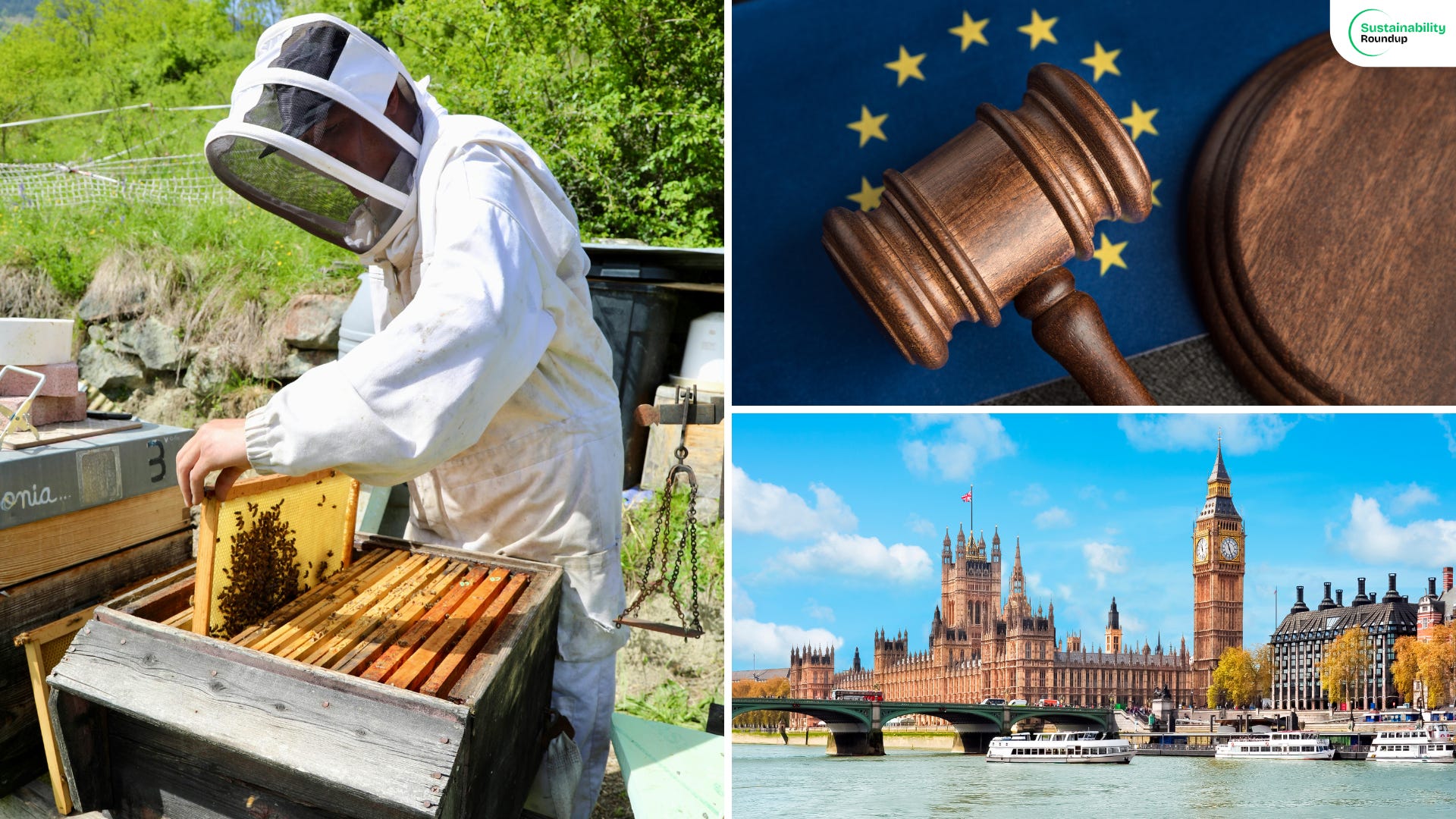
1. Britain Sets 87% Emissions Cut Target by 2040 as Energy Price Pressure Mounts
The UK has announced a new target to reduce greenhouse gas emissions by 87% by 2040, reinforcing its commitment to long term decarbonisation despite continued concerns over energy affordability and economic competitiveness. The announcement signals policy certainty for investors and clean technology developers, yet the credibility of the target will ultimately depend on how governments balance climate ambition with public acceptance of higher transition costs and infrastructure investments. Companies operating in the UK now face a clearer direction of travel, making delayed transition planning increasingly risky.
2. South Korean Beekeepers Count the Cost of Climate Change
South Korean beekeepers are reporting significant losses as rising temperatures, shifting flowering seasons, and extreme weather disrupt bee populations and honey production. While the story highlights climate change’s growing impact on agriculture and biodiversity, it also exposes how adaptation policies often focus on large industries while overlooking smaller ecosystem dependent sectors that quietly underpin food security. Businesses relying on natural capital may need to reassess risks previously considered too indirect or localised.
3. EU Warns 20 Member States Over Failure to Adopt Anti Greenwashing Rules
The European Union has formally warned 20 member states for failing to implement anti greenwashing regulations designed to improve the accuracy and transparency of environmental claims. The move demonstrates regulators’ increasing focus on the integrity of sustainability communications, but it also highlights how regulatory effectiveness can be undermined when policy adoption lags behind political commitments. As scrutiny of sustainability claims intensifies, competitive advantage may increasingly depend on demonstrable performance rather than sustainability marketing.

Research published in Environmental Impact Assessment Review, SEA and Strategy Formation Theories: From Three Ps to Five Ps, challenges a common sustainability assumption: that ambitious plans automatically translate into meaningful outcomes. Drawing on Mintzberg’s Five Ps of Strategy, the authors argue that sustainability challenges are too complex and dynamic to be managed through planning alone.
Sustainability failures often stem from treating sustainability as a roadmap rather than a strategic capability. As regulations, technologies, and stakeholder expectations evolve, organisations must continuously adapt rather than simply execute predetermined plans.
The strongest indicator of sustainability performance is often organisational behaviour, not public commitments. Repeated investment, procurement, innovation, and operational decisions ultimately determine whether sustainability goals are achieved.
Sustainability creates competitive advantage when it shapes market positioning and decision making, rather than remaining confined to reporting and compliance functions.
The paper's most important insight is that sustainability leadership is often constrained not by a lack of commitments, but by a narrow understanding of strategy itself. Many organisations continue to manage sustainability through plans, targets, and disclosures, while the organisations creating the greatest long term value are embedding sustainability into decision making, organisational behaviour, and competitive positioning.
Read more here.

Listen to whether fibre based packaging can replace flexible plastics as regulatory pressure and packaging waste requirements intensify globally. The discussion highlights a growing strategic challenge for businesses: balancing recyclability, product protection, supply chain efficiency, and cost without creating unintended environmental trade offs.
As circular economy expectations rise, companies that focus on material substitution alone risk shifting impacts elsewhere in the value chain, exposing themselves to future operational, compliance, and reputational risks.

Missed our recent issues? Catch up anytime by reading our full archive here 📖.
That’s it for today’s roundup! We’ll see you next Thursday with another set of inspiring sustainability news and updates. Until then, take a moment to reflect on how you can adopt one new sustainable practice this week. Every small step counts! 🌍✨
Have any thoughts or a sustainable practice you'd like to share? Share your feedback here.
Together, we can make a difference. See you in the next edition of the Sustainability Roundup!
Sustainability failures aren't usually a lack of ambition; they're a category error: treating sustainability as a plan to execute rather than a capability to embed. The difference matters because plans become obsolete the moment regulations, technology, or consumer expectations shift. Capabilities like procurement criteria that price in circularity, or investment committees that apply a carbon test before approving capex, create adaptive organisations. The question every sustainability professional should ask themselves: "If our sustainability team disappeared tomorrow, would our next major business decision look any different?" If the answer is no, you haven't built a strategy, you've built a reporting office.
Something you said at the beginning - "As sustainability moves deeper into business strategy, competitive advantage will increasingly belong to those that can translate commitments into measurable action" really resonated with me. There are so, so many companies claiming to be "sustainable," "clean," "green," "planet-friendly," etc. to the point where so many of those buzzwords are simply that - just buzzwords. There's no depth behind them. Where we'll begin to see real sustainable companies shine is in their measurable outcomes over the next few years. The actual results will be the differentiator, not the claims.