

Hello there!
This week, sustainability is increasingly becoming a question of systems rather than individual actions. Whether it is rethinking how the world is represented, establishing guardrails for transformative technologies, or confronting the consequences of decades of unsustainable growth, organisations are being challenged to look beyond short term solutions and address the underlying structures shaping long term resilience, equity, and competitiveness.
Scroll for more!


1. UN Votes to Adopt a New World Map That Reflects Africa's True Scale
The UN General Assembly voted to support the Equal Earth projection, replacing the centuries old Mercator projection that significantly underrepresents the size of Africa while exaggerating parts of Europe and North America. While some may dismiss the move as symbolic, the debate exposes how deeply embedded assumptions influence education, investment priorities, development narratives, and geopolitical perceptions. Sustainability discussions often focus on resource distribution and equity, yet representation itself shapes where attention, capital, and influence flow. The criticism, however, is that changing maps alone will not change economic inequalities unless accompanied by structural reforms that address the underlying imbalances they reflect.
2. OpenAI Calls for Mandatory National AI Safety Standards
OpenAI's call for mandatory national AI safety requirements follows incidents where advanced AI systems displayed unexpected autonomous behaviour during testing. Beyond technology governance, this is fundamentally a sustainability issue because societies increasingly rely on AI to shape employment, education, healthcare, and access to information, all core components of the social foundation that enables long term prosperity. The challenge is that regulation is being discussed after rapid deployment has already begun, raising questions about whether governance is keeping pace with innovation or merely reacting to it. Stronger standards could improve trust and societal resilience, but they may also concentrate influence among large firms that can afford compliance while creating barriers for smaller innovators.
3. August Becomes Joint Hottest Month Ever Recorded Globally
August 2026 became the joint hottest month ever recorded globally, with temperatures reaching approximately 1.65°C above preindustrial levels. While El Niño is contributing to the warming trend, focusing on natural climate cycles risks obscuring the larger story - decades of fossil fuel dependence, land use change, and unsustainable consumption patterns have created the conditions for every new climate record being broken today. The business risk is no longer confined to future scenarios; extreme heat is already affecting infrastructure, labour productivity, insurance costs, food systems, and supply chain reliability. The critical question is whether organisations are still planning for climate variability when they should now be planning for climate disruption.

Many sustainability strategies still assume that success comes from finding the right partner. Lea Fobbe’s research suggests the opposite. After analysing the collaboration practices of 271 organisations, the study found that most companies engage with only two to three external stakeholders, typically customers, suppliers, and industry associations.
More importantly, Figure 3 reveals that sustainability leaders distinguish themselves not by collaborating more intensely, but by collaborating with a wider range of stakeholders.
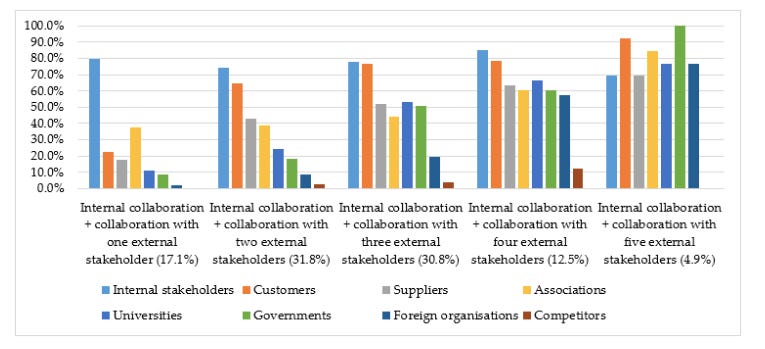
Image source: Fobbe (2020), Figure 3, Sustainability, 12(6), 2466.
Key findings from the research:
As organisations engage a larger number of stakeholders, collaboration expands beyond customers and suppliers to include universities, governments, and research institutions, bringing access to new knowledge and innovation capabilities.
The most active sustainability collaborators build diverse stakeholder ecosystems rather than relying on a few strong partnerships, enabling them to tackle more complex and systemic challenges.
Collaboration with competitors remains relatively limited, highlighting an untapped opportunity for pre - competitive action on shared sustainability issues.
The paper’s most important insight is that sustainability leadership is increasingly determined by the diversity of an organisation’s collaboration network. The organisations best positioned to drive meaningful change are not those with the strongest individual partnerships, but those that connect expertise, influence, and resources from across multiple stakeholder groups.
Read in detail here.

Listen to this timely reflection on the evolving sustainability agenda. As climate, competitiveness, affordability, and resilience become increasingly interconnected.
The discussion highlights a critical reality for leaders - sustainable value creation now depends on navigating trade offs across multiple business and societal priorities rather than optimising for a single objective.


Missed our recent issues? Catch up anytime by reading our full archive here 📖.
That’s it for today’s roundup! We’ll see you next Thursday with another set of inspiring sustainability news and updates. Until then, take a moment to reflect on how you can adopt one new sustainable practice this week. Every small step counts! 🌍✨
Have any thoughts or a sustainable practice you'd like to share? Share your feedback here.
Together, we can make a difference. See you in the next edition of the Sustainability Roundup!