

Welcome back to Sustainability Roundup!
This week, sustainability challenges are increasingly becoming trust challenges. From economic reforms and emerging technologies to carbon removal markets, organisations are learning that innovation and investment alone are not enough. Long term success depends on earning legitimacy, reducing uncertainty and maintaining stakeholder confidence.
Scroll down for more!


1. Nigerians’ Cost of Living Pain Deepens as Election Looms
Nigeria’s economic reforms have improved investor confidence, yet many citizens continue to face rising living costs and declining purchasing power ahead of national elections. The story highlights a critical strategic lesson for both governments and businesses: efficiency gains and market reforms do not automatically translate into social legitimacy. Many organisations still assume that strong economic performance is sufficient to maintain stakeholder support, but public acceptance increasingly depends on whether the benefits of transition are perceived as fair and widely shared. Companies navigating energy transitions, supply chain transformations and sustainability programmes may need to focus as much on distributional outcomes as operational outcomes. The greatest risk is not failed reform but reform that loses its social licence to operate.
2. German Advocacy Group Files Criminal Complaint Over Meta AI Glasses
A German digital rights organisation has filed a criminal complaint against Meta over its AI enabled smart glasses, arguing that the technology creates unacceptable privacy risks through potential covert recording. The dispute demonstrates how trust is becoming a competitive constraint rather than simply a compliance issue. For years, technology companies focused on what innovation could achieve, while regulators increasingly focus on what society will tolerate. Sustainability discussions often concentrate on environmental performance, yet this case shows that social legitimacy may become an equally important determinant of growth. Businesses developing AI, data driven products and emerging technologies may find that public trust becomes a scarce strategic resource that cannot be retrofitted once stakeholder concerns have emerged.
3. Microsoft Backs Carbon Removal Through Wastewater Infrastructure
Microsoft’s latest agreement with CREW Carbon uses wastewater treatment infrastructure to remove carbon dioxide, signalling continued corporate investment in engineered carbon removal solutions. What makes the deal strategically significant is that it embeds climate action within existing infrastructure rather than relying on standalone offset projects. The announcement reflects a broader shift across sustainability strategy: competitive advantage increasingly comes from integrating environmental solutions into core operational systems. However, the long term challenge remains whether these technologies can scale rapidly and affordably enough to meet growing demand. The companies likely to benefit most from emerging carbon markets may not be those purchasing removals, but those helping build the infrastructure, standards and market architecture that make removals possible in the first place.

Many sustainability leaders assume that innovation is what regulators reward. The paper Strategic positioning and accelerating regulatory clearance for new ventures suggests something different - regulators often reward clarity before novelty. Analysing 239 venture backed medical technology firms, the authors found that organisations accelerated regulatory approval when they reduced complexity, aligned with familiar reference points and demonstrated legitimacy in ways regulators could quickly evaluate.
For executives, this raises four important questions:
Are we making our sustainability initiatives easy for regulators and stakeholders to understand?
Are we framing new sustainability solutions against recognised standards and proven examples?
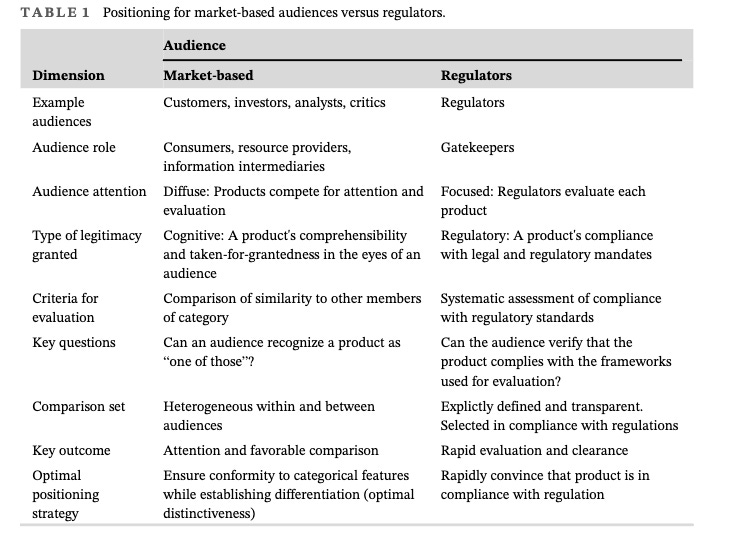
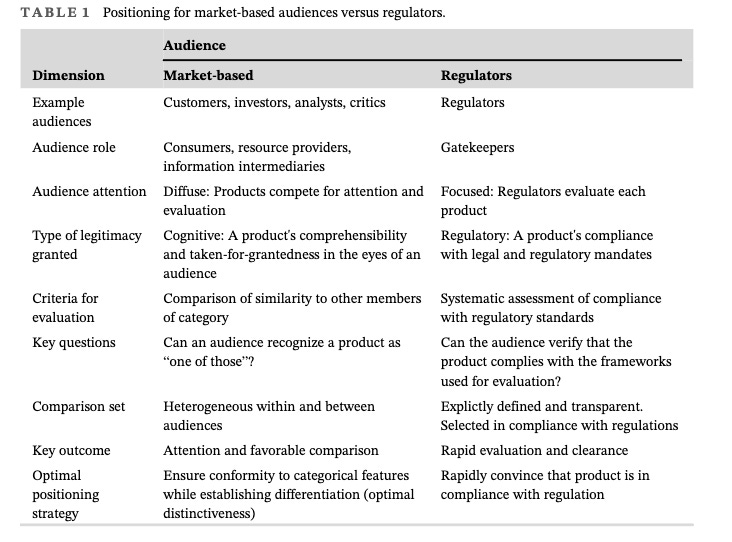
Image courtesy: Pahnke, Zuzul & Howard (2026), Strategic Management Journal
Have we earned enough credibility to use our own track record as evidence of future performance?
Where are we creating unnecessary complexity that slows approval, adoption or investment
The paper challenges a common assumption that the best strategy is to showcase how different your solution is. In regulated environments, legitimacy often matters more than distinctiveness. The firms that secured faster approvals were not necessarily the most innovative. They were the ones that made evaluation easier.
For sustainability leaders navigating climate disclosures, carbon removals, biodiversity credits and emerging regulations. Competitive advantage often comes from reducing stakeholder uncertainty rather than maximising perceived innovation.

Listen to David Grayson, Chris Coulter and Mark Lee speak with Aron Cramer, President and CEO of BSR, and Tensie Whelan of NYU Stern. They revisit the origins of the business case for sustainability, explore how companies create value through sustainability and argue for a more ambitious narrative.
A particularly thought provoking insight is that CSR activities alone reveal little about a company's true values. Instead, strategy, capital allocation, operations and leadership decisions provide a far clearer picture of organisational priorities.

Last week’s poll suggests that sustainability leaders increasingly view the challenge as internal rather than external. A majority 53% identified short term financial pressures as the biggest barrier to sustainable growth, compared with 21% for unsustainable business models, 16% for consumer demand and behaviour, and 11% for weak policy and regulation. The results indicate that the real obstacle may not be a lack of sustainability solutions, but the difficulty of prioritising long term value creation in systems focused on short term performance.

Missed our recent issues? Catch up anytime by reading our full archive here 📖.
That’s it for today’s roundup! We’ll see you next Thursday with another set of inspiring sustainability news and updates. Until then, take a moment to reflect on how you can adopt one new sustainable practice this week. Every small step counts! 🌍✨
Have any thoughts or a sustainable practice you'd like to share? Share your feedback here.
Together, we can make a difference. See you in the next edition of the Sustainability Roundup!