

Welcome back to this week’s Sustainability Roundup!
What gets rewarded gets done, and this week showed how often the rewards point the wrong way. New US rules will force farmers to pay for clean energy projects upfront before they can get any federal support. TikTok stands accused of giving children safety tools that only looked like they worked. And more than 130 companies, from Nestlé to Unilever, told governments to stop spending trillions of dollars a year on subsidies that damage the nature their businesses rely on. When incentives and intentions pull in different directions, incentives usually win. So this week, we ask a question every board should be asking: does tying executive pay to sustainability targets actually change anything?


1. 78% of Companies Raised Sustainability Investment, Citing Higher Returns
Deloitte’s 2026 C-suite Sustainability Report, based on more than 2,150 executives in 29 countries, found that 78% of companies increased sustainability investment last year, and 77% rated its returns higher than other investments. Financial benefit is now the top factor for judging initiatives (51%), well ahead of environmental outcomes (26%), and the average company now runs 3.4 initiatives, down from 5.0. Only 18% are transforming their business model, down from 40%. The good news is that sustainability is winning on business terms, but these are self-reported returns from the leaders who approved the spending, and the shift to fewer, safer projects risks squeezing out the harder, transformational work.
2. TikTok Gave Teens and Children a Placebo Safety Feature, New York Alleges
New York alleges in its lawsuit against TikTok that the company ran experiments in which thousands of users, including teens and children, switched on safety tools such as "Algo Refresh", meant to reset their feeds and stop harmful content, but their feeds did not actually change. Users outside the experiment received a working version. The case is one of more than two dozen brought by US states accusing TikTok of designing its platform to encourage addictive use by children and misleading users about safety. TikTok says it regularly tests new features to understand how they work in the real world. If proven, it's a stark example of safety features built to reassure rather than protect, much like sustainability claims made without real action.
3. 130 Firms Give Governments 12 Months to Redirect $2.6 Trillion in Nature-Harming Subsidies
More than 130 companies and financial institutions, including Nestlé, Unilever, H&M Group, Danone, Ørsted and Legal & General, are urging governments to launch national plans within 12 months to reform the at least $2.6 trillion a year in public spending that depletes the natural resources supply chains rely on. The signatories, with combined revenues above $600 billion and more than $4.7 trillion in assets under management, want to “make the resilient choice the competitive choice” ahead of the UN biodiversity summit COP17. It’s rare to see business lobbying for tougher rules rather than against them, and the logic is commercial - harmful subsidies price nature destruction below its true cost.

The most obvious way to build commitment is to tie executive bonuses to sustainability targets, and companies are doing it fast. According to Executive Compensation Tied to ESG Performance: International Evidence by Cohen, Kadach, Ormazabal and Reichelstein, the share of large listed firms using sustainability metrics in executive pay jumped from just 1% in 2011 to 38% by 2021. Yet earlier research found that adding money to sustainability targets can actually weaken how well they are completed. So does sustainability linked pay work? The answer depends on how it is designed.
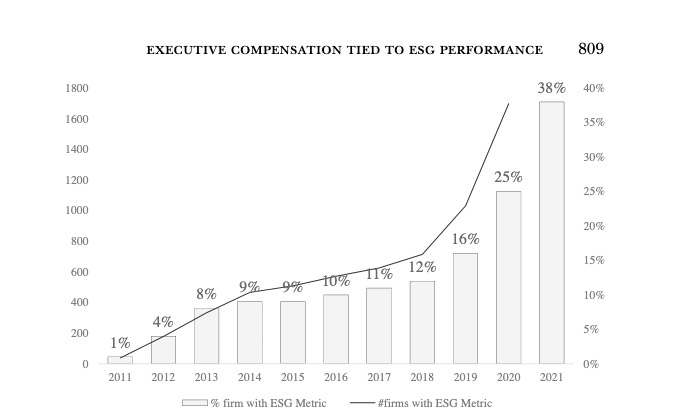
Image courtesy: Fig. 1, Cohen, Kadach, Ormazabal & Reichelstein (2023), Journal of Accounting Research
Where sustainability linked pay works
It moves sustainability outcomes. Firms that adopted sustainability linked pay saw improvements in key sustainability outcomes, including better ratings and lower carbon emissions, with the clearest gains in Europe.
It follows the stakes. Sustainability linked pay was more common in environmentally intensive industries and in countries with stronger sustainability expectations, which suggests companies are using it where sustainability matters most to the business.
It aligns leaders with investors. Adoption was linked to engagement and voting by institutional investors, so sustainability linked pay often reflects what shareholders are actively asking for.
Where it backfires
No financial upside. The improvements in sustainability outcomes did not come with better financial performance, which makes the business case harder to defend in a tough year.
An easier route to a bonus. Sustainability linked pay was associated with higher variable pay for executives, raising the risk that vague metrics become a soft target that boosts payouts.
Too much room for window dressing. Many sustainability metrics are qualitative, and companies rarely disclose how they are weighted or how payouts are calculated.
Designing incentives right
For sustainability managers advising boards, the research points to clear design choices - tie bonuses to absolute metrics like tonnes of emissions rather than vague “sustainability progress”, make sustainability metrics replace part of existing bonuses instead of adding an extra payout, and anchor targets to frameworks like SBTi so they aren’t quietly negotiated down. Above all, pay alone won’t build lasting commitment; that comes from regular feedback and leaders who genuinely believe in the target.

Listen to how a company can turn decarbonisation into a growth strategy by linking it to a problem customers urgently need solved. The strategic lesson for any organisation is that sustainability goals last longest when they sit inside the core business rather than beside it.
When climate action also expands markets, strengthens infrastructure or opens new customer segments, it earns lasting budget, leadership attention and investor support, even when political winds shift.

Missed our recent issues? Catch up anytime by reading our full archive here 📖.
That’s it for today’s roundup! We’ll see you next Monday with another set of inspiring sustainability news and updates. Until then, take a moment to reflect on how you can adopt one new sustainable practice this week. Every small step counts! 🌍✨
Have any thoughts or a sustainable practice you'd like to share? Share your feedback here.
Together, we can make a difference. See you in the next edition of the Sustainability Roundup!