

Hi there!
This week the state stepped back from pricing carbon and stepped forward to socialise climate loss. Brussels handed heavy industry €8 billion of free permits, Washington erased federal carbon limits on power plants, and the Commission launched an insurance alliance because three-quarters of Europe’s climate losses are uninsured. Policy is no longer a reliable forcing function for decarbonisation, while physical risk compounds regardless. Strategy must become capability-led, and this week’s research shows the fastest route to capability is learning through alliances.


1. EU countries back plan to give industries more free CO2 permits
EU member states backed an extra 121 million free ETS allowances for chemicals, metals, glass and ceramics over 2026–2030, worth about €8.25 billion in avoided carbon costs and more than the Commission proposed. A system designed to shrink free allocation just reversed direction in the name of competitiveness. The lesson: when carbon pricing and industrial policy collide, the carbon price loses. Treat carbon cost as a negotiated variable, not a planning constant, and separate what you decarbonise for regulators from what you decarbonise for customers, financiers and energy security. Only the second is durable.
2. EPA to undo carbon emission limits for power plants at G20 meeting
The US EPA finalised the repeal of federal greenhouse gas limits on coal- and gas-fired plants, announced at a G20 energy ministers’ meeting in Houston. The rules would have cut roughly a billion tonnes of CO2 by 2047 from a sector responsible for nearly a quarter of US emissions. Litigation will follow, but the strategic point is broader: regulatory decarbonisation is now cyclical, not secular, on both sides of the Atlantic. That raises the value of contractual decarbonisation, meaning long-dated clean power agreements, supplier covenants and investor commitments that survive an election. Policy risk is not a downside scenario; for regulation-led strategies it is the base case.
3. EU to launch climate insurance scheme after summer of extreme weather
After a summer of record wildfire, drought and heat, Ursula von der Leyen announced a Climate Insurance Alliance pooling insurers, investors, risk modellers and public authorities to scale group and parametric cover. Only a quarter of the bloc’s climate losses are insured; national budgets have become the insurer of last resort. Note the shape of the response: a multi-party alliance to build a market no single actor can build alone. For business, climate risk is moving from a disclosure item to a cost-of-capital item. Uninsurable assets will trade at a discount; resilient operations and strong risk data will be repriced upward.

Hübel, Weissbrod and Schaltegger (Long Range Planning, 2022) studied a $2.7 billion European meat company that partnered with nine startups making plant-based, insect-based and lab-grown protein. Textbook thinking says firms first get to know a partner, then learn skills from them. Here, getting to know the partner mattered the whole way through, and real skill transfer happened in only three of nine partnerships, and only after the company overcame its initial resistance to startups it once saw as the enemy. The authors call this the inhibition threshold.
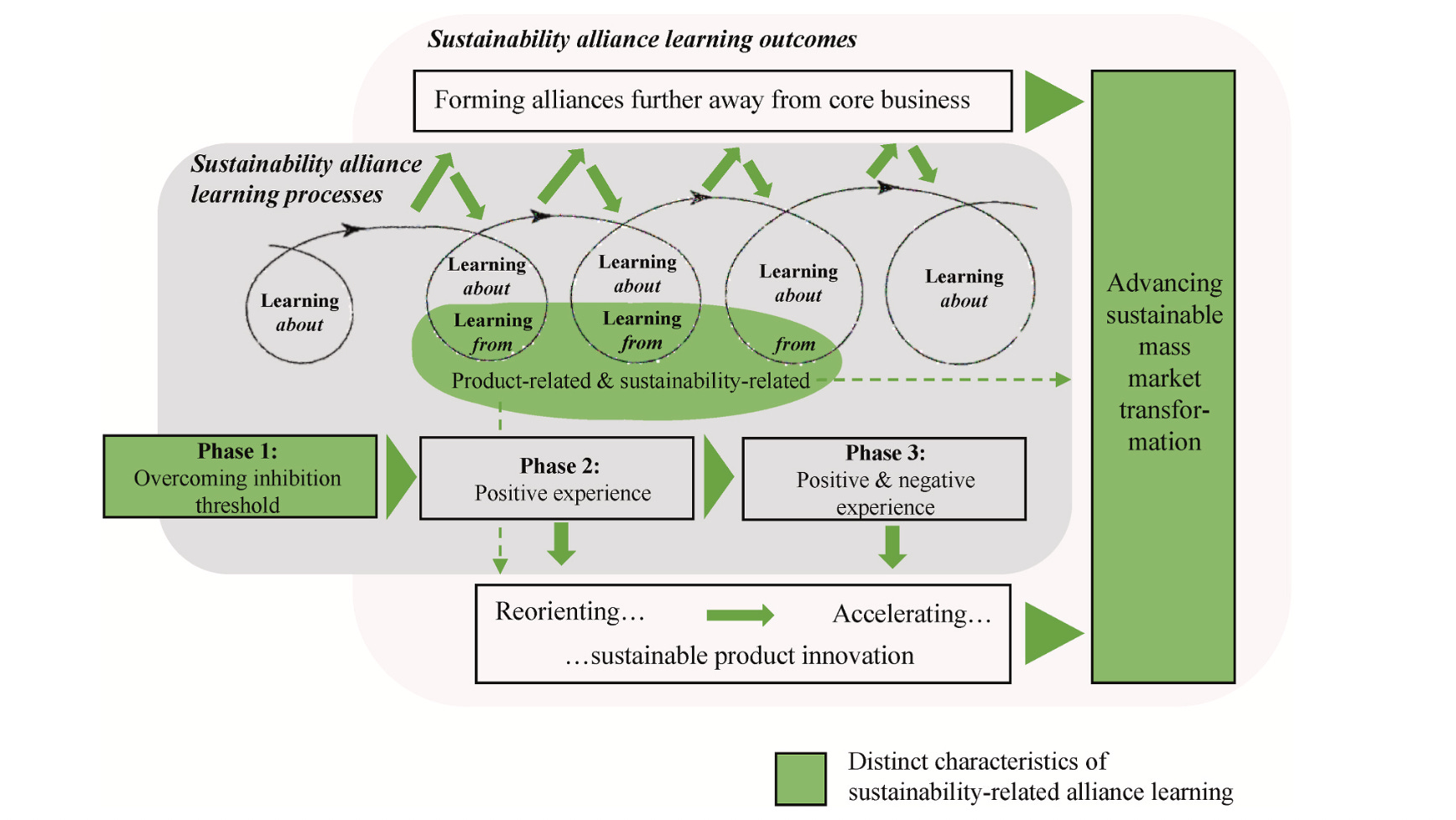
Image source: Fig. 4 Hübel, Weissbrod & Schaltegger (2022), Long Range Planning, CC BY-NC-ND 4.0.
Figure 4 shows three phases: getting past resistance, positive learning, then friction and dependence on startups with closer consumer ties. Surprisingly, the friction helped - it pushed the company to speed up its own product development, partner further from its core, and co-found an accelerator and joint venture, with a target to grow alternative proteins from 5% to 25% of revenue.
Key lessons for sustainability leaders:
Judge partnerships by what you learn about the partner and their market, not only what you take.
Run a portfolio: one alliance delivered most of the learning, but nobody knew which in advance.
Plan for early resistance: the first partnership was kept secret, yet it made every later one possible.
The bottom line: in a week when regulation stopped pulling, the firms that keep moving will be the ones that learn faster than they can build, and that means partnering.
Read in detail here.

Listen to why sustainability teams are among the first in line for AI automation: much of their work repeats every year and is heavy on data, such as checking supplier risks, collecting numbers and running due diligence.
If routine sustainability work is automatable, the function’s remaining value lies in system design, judgement and external relationships. Alliance capability, the ability to learn about and from partners, becomes the scarce skill.


Missed our recent issues? Catch up anytime by reading our full archive here 📖.
That’s it for today’s roundup! We’ll see you next Thursday with another set of inspiring sustainability news and updates. Until then, take a moment to reflect on how you can adopt one new sustainable practice this week. Every small step counts! 🌍✨
Have any thoughts or a sustainable practice you'd like to share? Share your feedback here.
Together, we can make a difference. See you in the next edition of the Sustainability Roundup!