

Welcome back to this week's Sustainability Roundup.
This week really highlighted how climate change is no longer just about commitments, but about how prepared we actually are. From Europe's extreme heat to shifting approaches in climate finance, the conversation is moving beyond net zero targets towards a more difficult question - are our institutions, businesses and partnerships resilient enough for the world we are already living in?
Scroll to find out!

1. Europe’s Heatwave Exposes the Net Zero Adaptation Gap
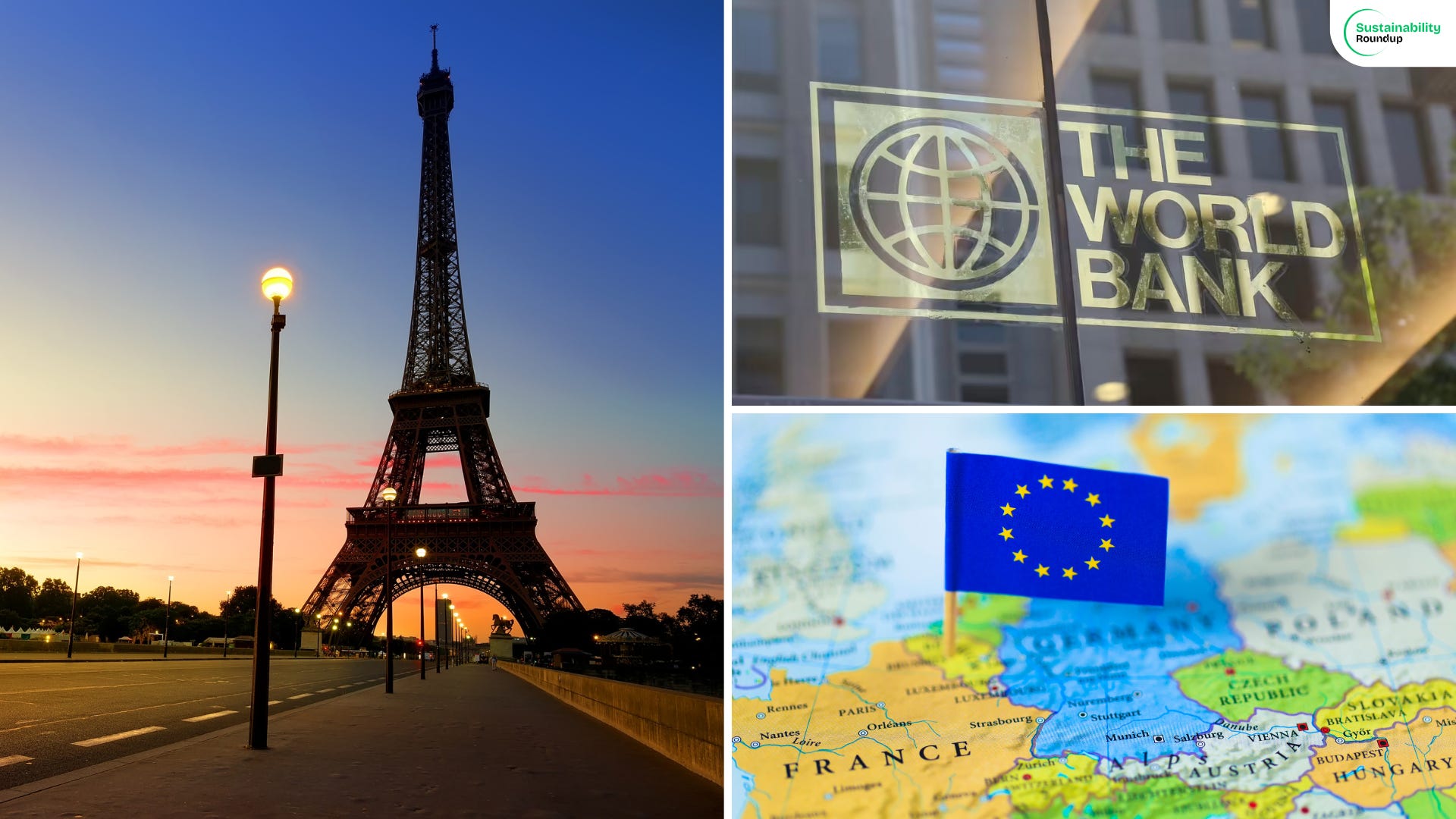
Europe has established itself as a global leader on net zero, yet this week’s record breaking heatwaves, wildfires and infrastructure disruption reveal that ambitious emissions targets alone cannot protect economies already experiencing climate impacts. The growing focus on adaptation exposes a critical blind spot in climate strategy, suggesting that governments have invested far more political capital in mitigation than in preparing businesses and communities for inevitable climate risks. Organisations should now treat climate resilience as a core strategic capability alongside decarbonisation rather than viewing adaptation as a secondary environmental initiative.
2. France’s Heatwave Response Triggers Political Fallout
France’s Green Party has announced plans to table a no confidence motion against the government over its handling of the recent deadly heatwave, arguing that inadequate preparation left the country vulnerable as another period of extreme heat approaches. While the motion is unlikely to succeed, it highlights a broader shift in climate governance where governments are increasingly being judged not only on emissions targets but on their ability to protect citizens and infrastructure from climate impacts. For businesses, this reinforces that climate adaptation is becoming a measure of leadership and institutional resilience, not simply an environmental policy objective.
3. World Bank Drops Its Climate Lending Target
The World Bank has announced it will retire its target of directing 45% of annual lending towards climate related projects, shifting instead to measuring development outcomes rather than climate finance inputs. While the move reflects a broader emphasis on flexibility and client driven development, it also raises concerns that removing clear targets could weaken accountability and political commitment to climate finance at a time when developing economies face escalating climate risks. The bigger strategic question is whether institutions can maintain credibility on climate action without measurable commitments, or whether outcome focused approaches risk diluting ambition over time.

Many sustainability challenges cannot be solved by a single organisation. Value Network Analysis helps businesses understand how suppliers, customers, regulators, NGOs and complementors collectively create value, revealing that competitive advantage increasingly depends on strengthening the ecosystem rather than optimising individual firms.
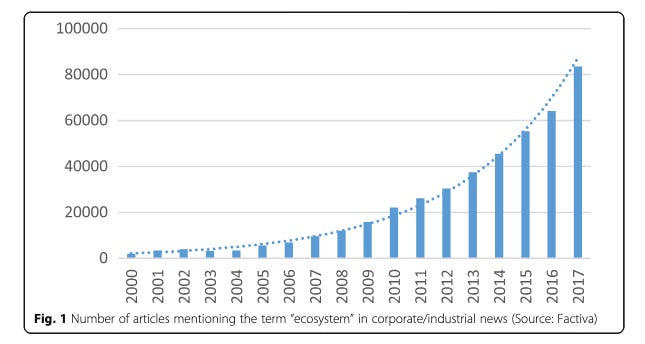
Academic research by Rahul Kapoor (Ecosystems: Broadening the Locus of Value Creation, 2018) defines an ecosystem as a network of interdependent organisations whose combined capabilities create value that no single firm could deliver alone, and argues that firms create greater value when they effectively coordinate complementary partners within an ecosystem, where the collective capabilities of participants determine innovation and market success.
Kapoor illustrates this through the smartphone ecosystem, where firms like Apple create value not only through their own products but by orchestrating a broader ecosystem of app developers, component suppliers and platform partners. This ecosystem perspective highlights that competitive advantage increasingly depends on how well organisations design, manage and strengthen the ecosystems in which they operate.
Image Courtesy: Figure 1, Ecosystems: Broadening the Locus of Value Creation (2018).

Watch how climate data rarely changes behaviour on its own, but compelling narratives can influence public opinion, policy and business decisions.
This episode explores how climate stories are framed, why adaptation is often underreported, and the challenge of communicating urgency without creating despair, offering valuable insights for sustainability professionals seeking to turn evidence into action.

Results from last week show that 69% of readers believe extreme heat should now be treated as a core business continuity risk. The strong consensus reflects a growing recognition that climate resilience is no longer solely an environmental concern but a strategic imperative influencing operations, investment decisions and long term competitiveness.
Missed our last issue? Read here.
Missed our recent issues? Catch up anytime by reading our full archive here 📖.
That’s it for today’s roundup! We’ll see you next Thursday with another set of inspiring sustainability news and updates. Until then, take a moment to reflect on how you can adopt one new sustainable practice this week. Every small step counts! 🌍✨
Have any thoughts or a sustainable practice you'd like to share? Share your feedback here.
Together, we can make a difference. See you in the next edition of the Sustainability Roundup!
The document “Is Sustainability Becoming Adaptation?” highlights an important shift in climate thinking: sustainability can no longer be viewed solely in terms of emissions reduction and the goal of net-zero emissions, as heatwaves, wildfires, and infrastructure disruptions show that societies must also prepare for climate impacts that are already occurring.
The European example illustrates a genuine adaptation gap, where mitigation efforts appear to have received greater political attention than the preparation of populations, businesses, and infrastructure for climate risks.
The French case further shows that the ability to protect citizens is gradually becoming a criterion of climate governance, while the discussion surrounding the World Bank raises the question of whether climate action should be measured by the funding committed or by its actual outcomes. Finally, the emphasis on stakeholder ecosystems reminds us that resilience cannot always be built by an organization acting alone.
Thus, the document calls for moving beyond a vision of sustainability focused exclusively on “net zero” toward an approach that simultaneously integrates mitigation, adaptation, resilience, and cooperation among stakeholders: the climate challenge is therefore no longer simply about how to prevent future changes but also about how to make our societies capable of functioning sustainably in a climate that has already changed.