

Hi there! 👋
This week’s stories highlight a powerful shift in the sustainability landscape: the biggest risks and opportunities are increasingly emerging outside company walls. From the rise of private climate data markets and hidden environmental risks in global supply chains to geopolitical fractures influencing climate ambition, external forces are now shaping corporate strategy just as much as internal commitments. Navigating this evolving landscape requires sharper systems thinking, stronger leadership alignment, and a more resilient approach to long term sustainability planning.

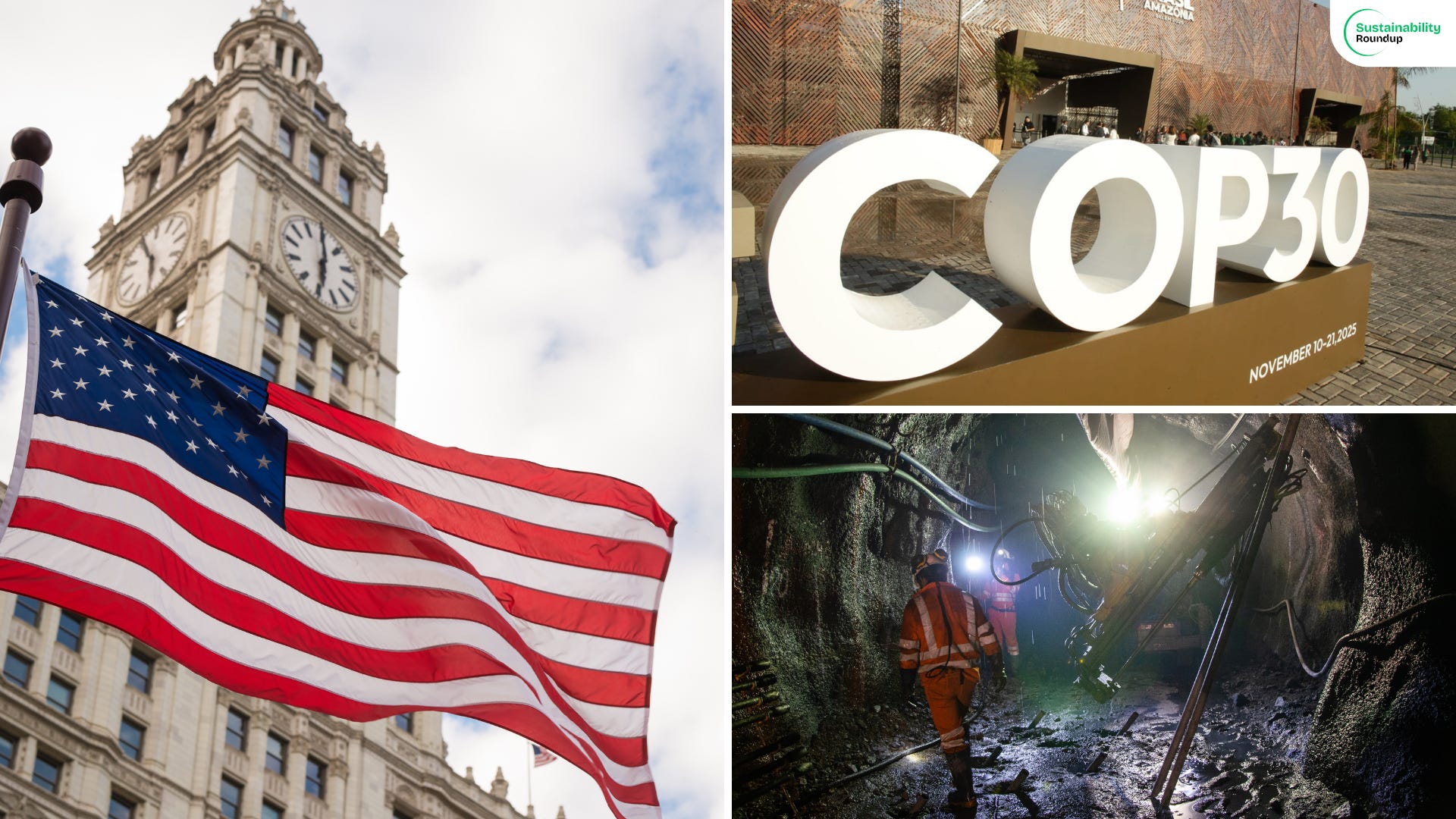
1. US government pullback from climate science fuels boom for private data firms. ➡️📊
Private data companies are rapidly scaling up to fill the gap left by cuts to publicly funded climate science, offering tools for drought risk, pollution monitoring, and mineral mapping. This reflects surging demand for climate risk intelligence but raises concerns about transparency and equitable access to essential environmental data. The shift also risks creating information asymmetry, where only firms able to pay for high quality datasets can manage climate exposure effectively. Strategically, companies may need to diversify data sources to avoid over-reliance on private climate models.
2. Toxic mines put Southeast Asia’s rivers and people at risk. 🌊⚠️
New findings show more than 2,400 river-adjacent mines may be releasing harmful chemicals across mainland Southeast Asia, threatening millions who rely on those water systems. The study highlights persistent externalisation of environmental and health costs and reinforces the need for stronger regional mining oversight. This exposure also presents operational and financial risk for companies sourcing from the region, where contaminated rivers threaten community stability and long term supply security. It signals that environmental negligence is increasingly a systemic risk, not a localised one.
3. G20 endorses climate resilience and renewable energy goals despite US boycott. 🌍⚡
At the Johannesburg summit, G20 members adopted commitments on debt relief, climate resilience investment and clean energy transition, even without US participation. The move signals rising Global South leadership but also exposes key geopolitical fractures that could affect global climate coordination. The declaration may accelerate regional climate finance collaborations and south south technology partnerships as countries seek alternatives to US aligned frameworks. However, the absence of a major emitter raises concerns about fragmented global pathways to decarbonisation.

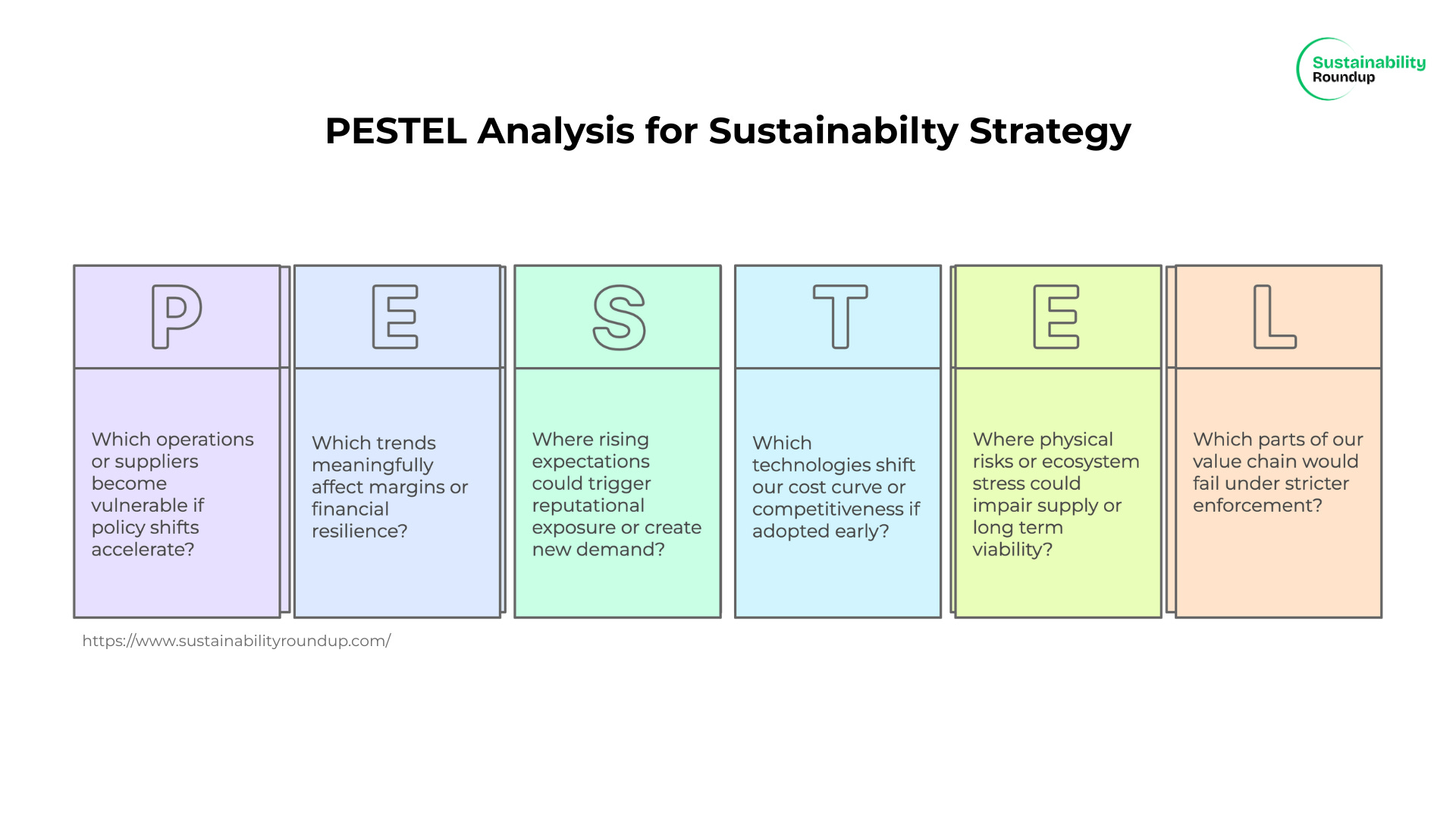
As sustainability becomes central to business strategy, leaders need a clear way to translate external shifts into strategic choices. PESTEL, as a structured external analysis tool, helps organisations understand how forces outside the company influence long term competitiveness.
Political: Track climate rules, trade measures, and governance quality to understand where future market access or due diligence expectations may tighten. 🏛
Economic: Map resource price trends, investor expectations, and insurance pressures to understand where sustainability can reduce cost exposure or unlock capital advantages. 💰

Sociocultural: Monitor consumer values, employee expectations, community pressure, and media narratives to gauge legitimacy risk. 👥
Technological: Identify low carbon, traceability, circular, and data technologies that can reduce footprint or disrupt competitors. 💡
Environmental: Assess climate risks, biodiversity dependence, water availability, and ecosystem impacts across assets and supply chains. 🌱
Legal: Anticipate due diligence, disclosure, product, and greenwashing rules together with litigation trends. ⚖️
A recent European study on bio economy innovation found that PESTEL effectively surfaced political, technological and market drivers, but sustainability transitions accelerated only when a seventh factor, infrastructure and institutional readiness, was added. Their PESTEL + I model shows that even strong sustainability strategies stall without enabling systems such as permitting processes, skills pipelines, public funding mechanisms, and supply chain infrastructure. This demonstrates that PESTEL remains powerful, but its value grows when companies consider not only external pressures but the institutional conditions shaping whether sustainability ambitions can realistically succeed. Read the study here.

Listen to “Rule 6: Leadership Must Own Your Sustainability Strategy,” where a 25-year sustainability practitioner explains why even the best designed strategy fails.
He talks without true executive ownership and leadership alignment, including emotional ownership of the mission rather than simple procedural approval, becomes the single strongest predictor of whether sustainability ambition turns into real operational change. Tune in now! 🎧

Last poll results show a 42% of respondents choosing financing models and 37% percent pointing to sustainable supply chains, the results signal that the biggest accelerators of corporate sustainability will come from how companies deploy capital and redesign operations, rather than from regulation, consumer pressure or emerging tech, a clear indication that transformation will be driven from the inside out.
Missed our recent issues? Catch up anytime by reading our full archive here 📖.
That’s it for today’s roundup! We’ll see you next Thursday with another set of inspiring sustainability news and updates. Until then, take a moment to reflect on how you can adopt one new sustainable practice this week. Every small step counts! 🌍✨
Have any thoughts or a sustainable practice you'd like to share? Share your feedback here.
Together, we can make a difference. See you in the next edition of the Sustainability Roundup!
Hi, I write about housing through the lens of policy, institutional structure, and climate. I’m interested in how systems shape outcomes, especially when intentions and results don’t line up. It’s nice to meet you.