

Hi there! 🌍
This week’s Sustainability Roundup captures investor activism intensifying as Norway’s wealth fund targets full value chain emissions, while Delhi’s air quality worsens post-Diwali amid weak governance. Meanwhile, Nvidia hits all-renewable power goals but faces Scope 3 emission challenges, showcasing the complexity of balancing ambition with operational limits. Read how these stories highlight the delicate interplay between accountability, innovation, and real-world sustainability outcomes. ✨🌱


1. Norway’s wealth fund doubles down on Scope 3 pressure on companies.💰
The Norges Bank Investment Management (Norway’s ~$2 trillion sovereign wealth fund) updated its climate strategy to expand its focus from Scope 1 and 2 to include Scope 3 (value chain) emissions, committing to direct board level engagement with the highest emitting companies. This signals a new era of investor activism where capital owners are forcing companies to account for their full climate footprint, yet the fund’s reliance on engagement over enforcement may limit tangible outcomes if corporate boards continue to treat Scope 3 as optional rather than integral to value creation.
2. Severe smog returns to Delhi as fire cracker season kicks off air quality alarms. 🌫️🔥
After Diwali festivities, New Delhi’s air quality plunged into the severe category as fireworks and stagnant weather combined to create a dense toxic haze across the city. With the Supreme Court’s recent decision to lift the fire cracker ban, the absence of firm government accountability underscores the policy vacuum driving recurring public health crises. This deepens long term urban sustainability risk as economic productivity, citizen health and global reputation all erode when governance continually prioritises short term appeasement over structural reform.
3. Nvidia achieves 100% renewable power for offices and data centres, but Scope 3 challenge looms. 💻🔋
Nvidia announced it has powered all offices and data centres globally with renewable electricity while urging its suppliers to disclose their emissions, marking a major milestone in clean energy adoption for high tech industries. Yet its largest climate risk remains downstream emissions from customers using its AI chips, a reminder that even sustainability leaders face limits when their value chain depends on energy intensive end use. The move highlights how next generation companies are integrating sustainability into growth strategies but also how innovation intensity can outpace true decarbonisation.

Supply chain sustainability has often been reduced to a technical checklist of emissions, efficiency and compliance. Pagell and Wilhelm’s (2025) argue that this view is incomplete. A supply chain cannot be sustainable if the people who operate it remain vulnerable or unheard. Social outcomes are strategic drivers of resilience, continuity and reputation, not secondary concerns. 📊
To operationalise this mindset shift, organisations should:
• Make social KPIs part of enterprise performance management, with leadership accountable for worker safety, fair wages and voice across the value chain.
• Link procurement to social value, using contract terms and supplier development to raise labour standards and support community wellbeing.
• Invest in shared value partnerships, collaborating locally to strengthen trust and reduce disruption risk during crises or market shifts.
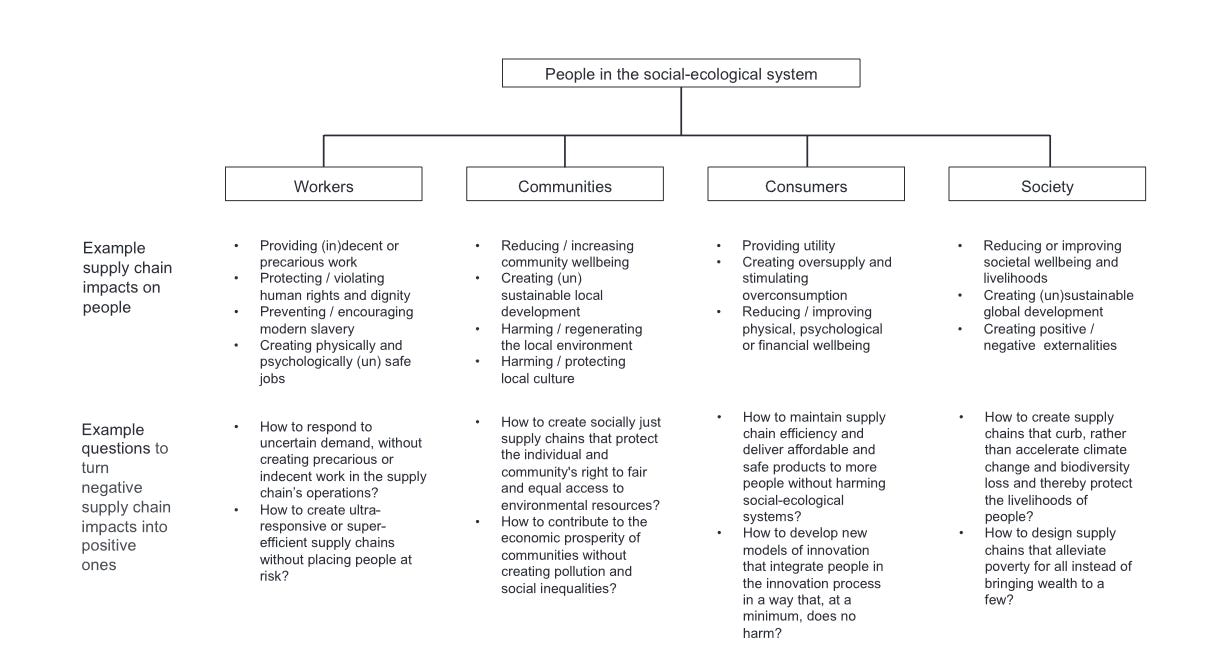
The message for leaders is straightforward: when people thrive, supply chains perform better. Human wellbeing is not a cost to manage, but an advantage to scale. 🤝 Read this study by Pagell and Wilhelm here.
Image courtesy: Pagell and Wilhelm, Putting the S in Sustainable Supply Chain Management, Journal of Supply Chain Management (Figure 1).

Sustainable solutions often emerge from ordinary challenges. Watch how a Mexican entrepreneur transforms millions of tons of invasive sargassum washing up on beaches into bricks for affordable housing, simultaneously tackling environmental and social challenges.
The idea is innovative, but it underscores a key reality: while regenerative solutions can outperform at the pilot stage, scaling them often runs into tough barriers like supply logistics, consistent material quality, and achieving economic competitiveness across multiple regions. 🌱🏗️

Last poll results show most favor government-led sustainability, but a significant share supports integrated policy, corporate, and stakeholder action. Effective climate response hinges on blending regulation with innovation and fostering multi-stakeholder collaboration for lasting impact. Read our last issue here. 🗳️

Missed our recent issues? Catch up anytime by reading our full archive here 📖.
That’s it for today’s roundup! We’ll see you next Thursday with another set of inspiring sustainability news and updates. Until then, take a moment to reflect on how you can adopt one new sustainable practice this week. Every small step counts! 🌍✨
Have any thoughts or a sustainable practice you'd like to share? Share your feedback here.
Together, we can make a difference. See you in the next edition of the Sustainability Roundup!